Last Updated on 22.03.2026 by DriverNew
If the manufacturer of your scanner or all-in-one printer did not provide convenient software for scanning documents and photos (images), you can use free tools: Windows Scan, Windows Fax and Scan, or NAPS2.
Important: These programs require a scanner driver to work correctly. If the manufacturer offers an official driver for your model, it is recommended to install that driver first. In cases where Windows installed the driver automatically and scanning works properly, reinstalling it is not necessary. However, if the scanner does not work or does not appear in the programs, install the original driver from the manufacturer. For instructions on how to install the driver correctly and solve problems that prevent the scanner from working, read this article.
Recommended Free Scanning Programs:
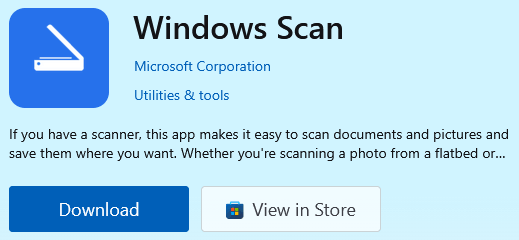
- Windows Scan — the official app from Microsoft. It can be downloaded for free from Microsoft Store in Windows 11, 10, and 8.1 (Windows activation is not required).
- Windows Fax and Scan — a standard program built into Windows 10, 8.1, 8, and 7. It does not require downloading and is ready to use immediately after the system is installed.
- NAPS2 — a free program for Windows 11, 10, 8.1, 8, and 7. It supports saving in PDF, TIFF, JPEG, and PNG formats, offers flexible settings, and includes optical character recognition (OCR).
How to Download and Use the Windows Scan App
Windows Scan is the simplest way to scan in Windows 11 and Windows 10. If the app is not installed, you can download it for free from Microsoft Store.
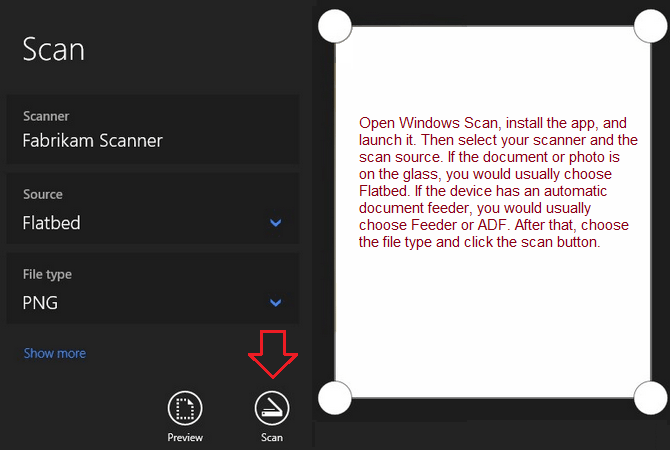
Install the app and launch it. Then select the scanner and the scan source. If the document or photo is on the glass, Flatbed is usually selected. If the device has an automatic document feeder, Feeder or ADF is usually selected. After that, choose the file type and click the scan button.
For regular documents, 300 dpi is usually enough. For photos, 300–600 dpi is usually selected. If you did not change the save folder, the finished file will most often be in Pictures\Scans.
If Windows Scan does not detect the device, cannot save the result the way you need, or if you need a multi-page PDF and more flexible settings, move on to NAPS2.
How to Use Windows Fax and Scan
Windows Fax and Scan is a classic built-in Windows program for simple scanning of documents and photos. This method is especially convenient for Windows 7, Windows 8, and Windows 8.1. On some computers with Windows 10, the program is also available.
Open the Start menu or Windows search, type Windows Fax and Scan, and launch the program. Click New Scan, select the device, then specify the profile, paper source, color mode, and resolution. If a preview is available, first click Preview, and then Scan.
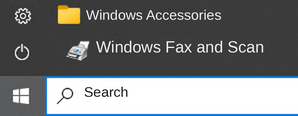
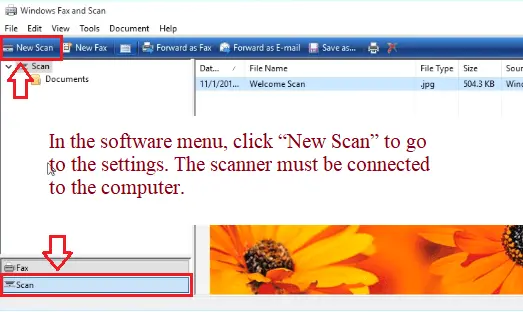
In the program menu, click New Scan to go to the settings. The scanner must be connected to the computer.
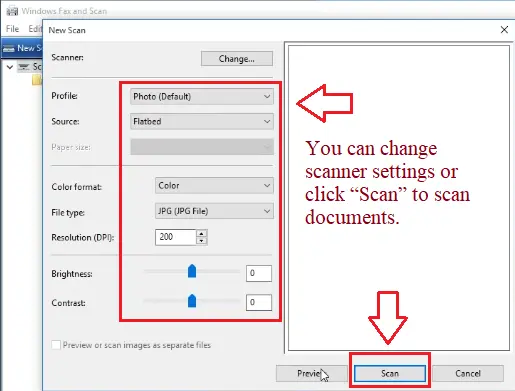
You can change the scanner settings or click Scan to scan documents.
For documents, 300 dpi is usually selected. For photos, 300–600 dpi is usually used. If the device has an automatic document feeder, make sure the correct paper source is selected. After scanning, the result will appear in the program window, and it can be saved to the desired folder on the computer.
How to Download and Use NAPS2
NAPS2 is a free scanning program that allows you to save files in PDF, TIFF, JPEG, and PNG, supports OCR, and is suitable for multi-page scanning. The latest version works with Windows 10 and Windows 11, and for Windows 7/8/8.1 the latest compatible version listed is 7.5.3.
The NAPS2 download page is in English, but the program itself supports more than 40 languages, and the language can be selected during installation.
To download the program, go to the official NAPS2 website
For Windows 10/11, download the current version of the program. For Windows 7/8/8.1, use version 7.5.3; the link to it is on the same page.
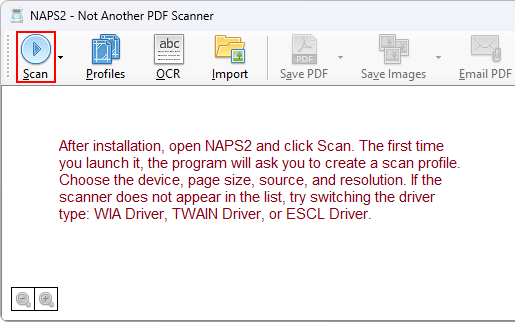
After installation, open NAPS2 and click Scan. When launched for the first time, the program will prompt you to create a scan profile. Select the device, page size, source, and resolution. If the scanner does not appear in the list, try switching the driver type: WIA Driver, TWAIN Driver, or ESCL Driver.
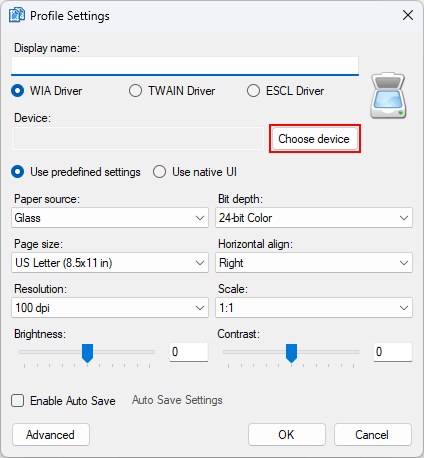
For documents, it is usually convenient to choose PDF and 300 dpi. For photos, JPEG or PNG and 300–600 dpi are usually selected. After scanning, the result will appear in the program window, and it can be saved immediately. If needed, you can continue scanning and add new pages to the same document.
NAPS2 is especially convenient if you need PDF, OCR, multi-page scanning, or more flexible settings than the built-in Windows programs provide.
If Scanning Does Not Work
If Windows detects only the printer but does not detect the scanner, check the driver. If the built-in Windows programs are not suitable, try NAPS2 and switch the driver type to WIA, TWAIN, or ESCL. If the automatic document feeder does not work, make sure that Feeder or ADF is selected as the source, rather than scanning from the glass.
Conclusion
If there is no convenient manufacturer program for your scanner or all-in-one printer, start with the method that suits your version of Windows.
For Windows 11 and Windows 10, it is usually most convenient to use Windows Scan. For Windows 7, Windows 8, and Windows 8.1, it is worth trying Windows Fax and Scan. If you need PDF, OCR, multi-page scanning, or more settings, use NAPS2.



Can i ask something please?i can;t find how i can add more than two pages at one and only folder-file.
Can you help me please find a solution?
thank you very much/
If you want to save more than two pages into one single file, the easiest solution is to use NAPS2 and save the result as PDF.
Here is how:
Open NAPS2.
Click Scan and scan the first page.
Scan the next pages one by one, or use the ADF / document feeder if your scanner has one.
Each scanned page will appear in the same NAPS2 window.
When all pages are added, click Save PDF — all pages will be saved into one file.
If you are using Windows Scan, multi-page scanning depends on the scanner driver and often works only with an automatic document feeder. If it does not let you combine all pages into one file, NAPS2 is usually the better option.